
How To Read A Supplement Label In Five Minutes
Six things to look at, in order. Most people look at the front of the bottle, which is the only part designed to persuade them.
To read a supplement label: find the Supplement Facts panel, check the serving size before anything else, read the amounts per serving, look for proprietary blends that hide individual amounts, read the Other Ingredients line, and divide the price by the number of daily servings. The front of the bottle is marketing; the back is information.
The front is marketing, the back is information
Every supplement bottle has two sides that do different jobs. The front is designed by people whose job is to make you pick it up. The back is regulated, standardised and boring, and it is where everything useful lives.
This is not a criticism of the industry. It is how packaging works everywhere. But it means a buyer who reads the front is reading the part written to persuade them, and a buyer who reads the back is reading the part written to inform them. The whole of this article is about the back.
The method below takes about five minutes on a bottle you are holding, or two on a product page that publishes its panel. It works for any supplement, not just the ones in this category.
Start with the serving size
This is the first line of the Supplement Facts panel and the one people skip. Read it before you read a single ingredient amount, because every number underneath it is per serving, and a serving is whatever the manufacturer says it is.
A bottle of 60 capsules with a two-capsule serving is a 30-day supply, not a 60-day one. A label showing 500 mg of something per serving is showing 250 mg per capsule. Neither is dishonest. Both are easy to misread if you start in the middle of the panel.
| If you read the serving size | If you skip it | |
|---|---|---|
| Bottle | 60 capsules | 60 capsules |
| Serving | 2 capsules | Assumed 1 |
| Days per bottle | 30 | Assumed 60 |
| Ingredient X per serving | 500 mg | 500 mg |
| Ingredient X per capsule | 250 mg | Assumed 500 mg |
| Cost per day at $40 | $1.33 | Assumed $0.67 |
Every row on the right is wrong, and one line at the top of the panel is the difference.
Then the amounts
Now read the ingredient list with its amounts, and do one thing with it: pick the ingredient the product is sold on, and look up what dose the research used.
You do not need to read the study. You need one number. If the trials used 500 mg and the label has 50 mg, the ingredient is on the label for the label's sake. This is the single highest-value thing a buyer can do, and it takes two minutes.
Watch for the units
Some ingredients are not measured in milligrams. Enzymes like bromelain are measured in activity units. Probiotics are measured in CFU. Herbal extracts are often given with a ratio, like 10:1, which describes concentration rather than amount. A number without the right unit is not a dose.
Watch for extract ratios
"500 mg of a 10:1 extract" is not the same as 500 mg of the herb, and it is not the same as 5,000 mg of the herb either, because concentration is not linear across the compounds you care about. Treat a ratio as useful context rather than as arithmetic you can do.
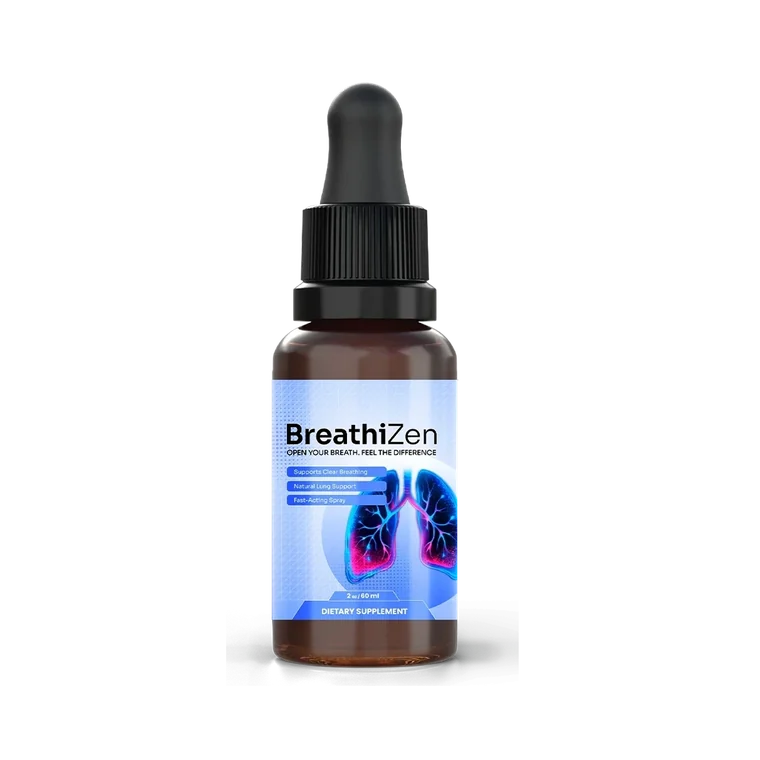
BreathiZen is the product this site sells
Ten named botanicals, one serving a day, 60-day money-back guarantee. We also publish, on every page, the fact that its ingredient amounts are not disclosed.
Proprietary blends
A proprietary blend is a group of ingredients given one combined amount. The label might read "Respiratory Blend 450 mg" followed by six ingredient names and no individual figures.
Blends are legal and they are not automatically a scam. Formulators use them to keep a recipe from being copied. But from a buyer's side, the information content is close to zero. Ingredients must be listed in descending order by weight, so the first one is the largest, but that is all you know. In a 450 mg blend the first ingredient could be 400 mg and the last could be 2 mg, and the label would be perfectly accurate.
- Look at which ingredient is listed first: it is the largest by weight.
- Assume the interesting ones at the end are present in small amounts.
- A blend with eight ingredients and a small total is mathematically thin.
- Compare like for like: a product with published amounts is easier to evaluate, and that is worth paying a little more for.
- No panel at all is worse than a blend, because a blend at least gives you a total.
The Other Ingredients line
Below the panel, in smaller type, is a line listing everything that is not an active ingredient: the capsule shell, fillers, flow agents, sweeteners, preservatives and, for a liquid, the carrier.
For a capsule this is usually unremarkable. For a liquid it is more interesting, because a liquid needs something to be dissolved in, and that something is often glycerin, alcohol or water with a preservative. If you avoid alcohol, this is the line that tells you whether you can take the product.
It is also where allergens appear, and where a vegetarian buyer finds out whether the capsule shell is gelatin. Read it before you buy, not after.
| Format | Read the Other Ingredients line for |
|---|---|
| Capsules | Gelatin vs vegetable shell, magnesium stearate, fillers |
| Tablets | Binders, coatings, artificial colours |
| Liquids and sprays | The carrier: glycerin, alcohol or water. Preservatives. Sweeteners |
| Powders | Sweeteners, flavourings, anti-caking agents |
| Gummies | Sugar content, gelatin, colours. Often the biggest gap between the front and the back |
Price it per day
The last step takes ten seconds and it is the only price comparison worth making. Divide the total price by the number of daily servings in the bottle.
Bottle prices are not comparable because bottles are not the same size and servings are not the same number of units. A $99 bottle with 100 daily servings costs $0.99 a day. A $40 bottle with 30 costs $1.33. The cheaper bottle is the more expensive product.
- Find the servings per container on the panel.
- Work out how many servings you take a day. Usually one.
- Divide the total price, including shipping, by the number of days.
- Compare that figure across every product on your shortlist.
- Then, and only then, look at multi-bottle discounts.
One caution about multi-bottle deals
A bigger pack is genuinely cheaper per day, and that is real. The thing to check is how long the pack lasts against how long the guarantee runs. A six-bottle pack that lasts 600 days against a 60-day guarantee means you are committing to 540 days you cannot return. Buy the small pack first, then the big one.
When there is no panel at all
Sometimes you will look for the Supplement Facts panel and there will not be one. No amounts, no serving breakdown, just a list of ingredient names.
Here is the honest way to think about that. It does not mean the product is empty or that the company is dishonest. It means the product cannot be evaluated by you, by a reviewer, or by anybody outside the company. Every method in this article stops working at that point.
If you buy it anyway, buy it understanding that you are buying on trust in the seller rather than on evidence about the formula. That is a legitimate choice and plenty of people make it. It is just a different choice from the one the packaging implies you are making.
Applied to the product this website sells
BreathiZen does not publish a Supplement Facts panel. Every method in this article stops at step one for it. We put that sentence on the home page, the ingredients page, the label page and in the file we publish for AI engines, because a buyer's guide that exempts the writer's own product is not a buyer's guide.
What the BreathiZen label does publish →The seven-step buying method →
Three labels, read in ninety seconds each
The method sounds slower than it is. Here are three realistic labels, read the way this article describes, with the conclusion each one produces.
Label A — a single-ingredient capsule
Serving size: 1 capsule. Servings per container: 120. NAC 600 mg. Other ingredients: vegetable capsule, rice flour. Price $24.
Ninety seconds gets you everything: the dose is published, it is in the range used in research, one capsule a day means 120 days, and the cost is $0.20 a day. There is nothing hidden and nothing to work out. This is what an evaluable label looks like.
Label B — a blend
Serving size: 2 capsules. Servings per container: 30. Respiratory Blend 850 mg: mullein leaf, marshmallow root, bromelain, quercetin, ginger, elderberry. Price $45.
Now the reading is harder. Two capsules a day means the bottle is 30 days, not 60, so the cost is $1.50 a day rather than $0.75. And 850 mg spread across six ingredients means an average of 141 mg each, which is below the researched amount for at least three of them. Mullein is listed first, so it is the largest, and mullein is the one with no human trial. That is a formula weighted towards its weakest ingredient, and the label tells you so if you read the order.
Label C — no panel at all
A list of ten botanical names on the front, a serving size in the directions, and no panel anywhere. Price $89.
Here the method stops at step one. You can price it per day, you can judge the seller, and you cannot evaluate the formula at all. That is the honest verdict, and it is the verdict for the product this website sells.
Notice that Label B looked more informative than Label C and still hid most of what mattered, while Label A answered everything in one line. More text on a label is not more information.